
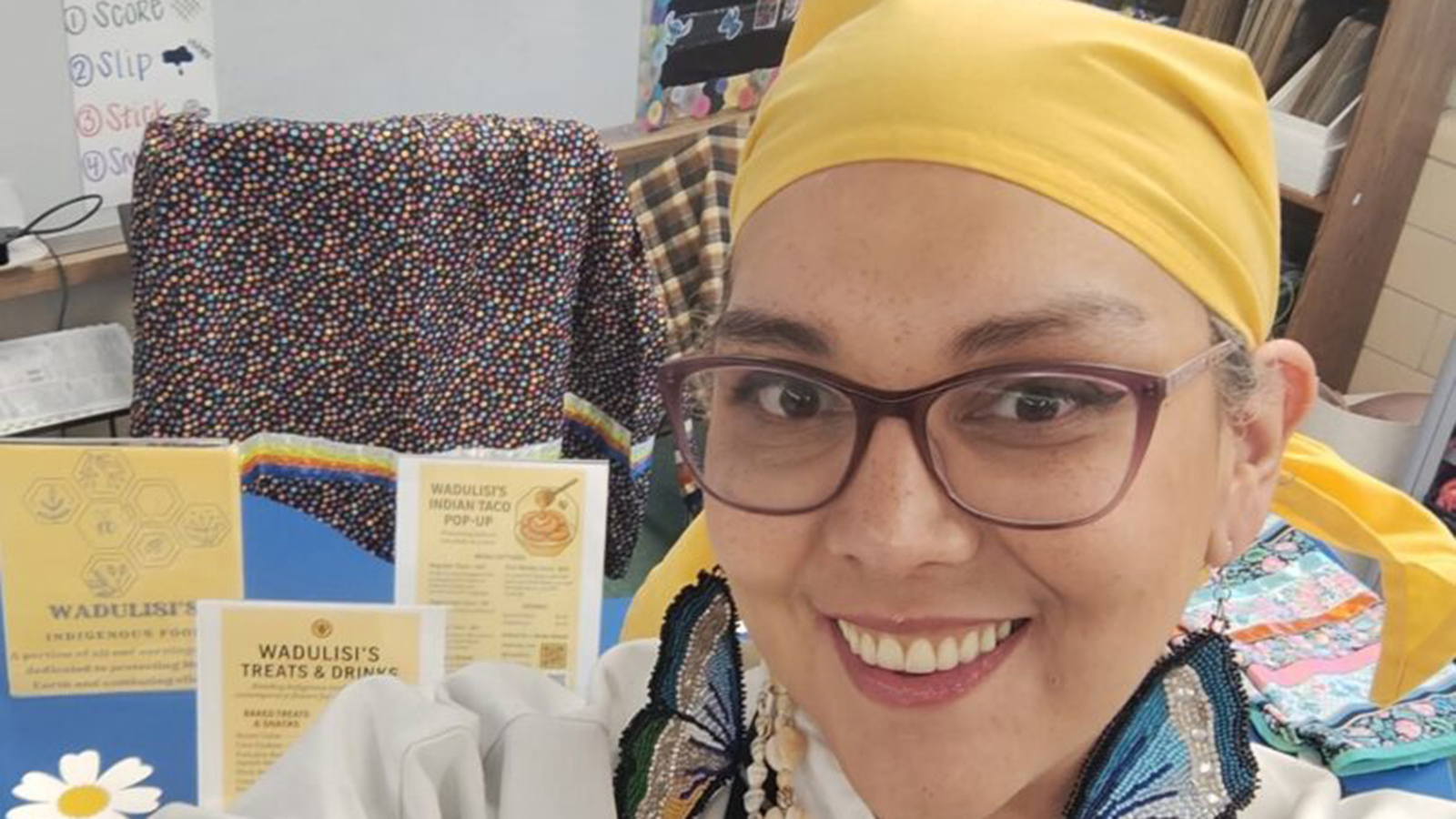
By Melissa Garrett, Cherokee Nation, Quapaw Nation, and Seneca-Cayuga Nation
Board Member, Shawnee Indian Mission Foundation
Author’s Note
I write this not as a scholar behind glass but as a woman who carries generations of stories, food ways, and memory. My ancestors walked through removal, assimilation, and reclamation. I now serve on the board of the Shawnee Indian Mission, standing inside that layered history, between the world that built this place and the peoples whose land made it possible. This paper is written in that intention: as an act of learning, bridge-building, and truth-telling.
Introduction: Resilience, Not Ruin
We can’t tell our story without acknowledging trauma; it shaped us, but that’s not where our story ends. Our ancestors were strong, clever, and adaptive. They didn’t just survive; they evolved. They found ways to turn hardship into wisdom, loss into teaching, and change into renewal. That’s what the Shawnee Indian Mission represents to me: a lesson in adaptation. It asks hard questions that still matter now. Are we still growing with each new challenge, or are we digging in our heels? Are we learning to bridge worlds, or repeating old divides? The people who built and walked this place were constantly adapting. Their story isn’t just history; it’s instruction.
A Gift of Land and Hope, Reconsidered
In 1838, the Shawnee Tribe sold approximately 2,000 acres of their own land to the Methodist Episcopal Church for the establishment of the Shawnee Indian Manual Labor School. This was not an act of surrender but one of foresight, a strategic decision to use education as protection. Records, including later court findings such as The Kansas Indians (72 U.S. 737, 1867), confirm that this was a legal and compensated transaction recognized by both the Tribe and the United States. The Kansas Supreme Court and subsequent rulings affirmed that the Shawnee were compensated and that their land rights were protected under treaty law. While no transaction of the 1830s can be fully separated from the inequities of its time, the evidence suggests that this one was entered into with consent and intent, not coercion.
Education was viewed as a shield. The Shawnee believed that understanding the colonizer’s language, religion, and trade would help protect what remained of their nation. This was an Indigenous strategy for survival, not a passive submission to outside will.
A People Already Adapting
By the time the Mission opened under Reverend Thomas Johnson in the late 1830s, the Shawnee and Cherokee had been living in contact with Europeans for nearly two centuries. The Cherokee had established farms, mills, and even a constitution before their removal west. The Shawnee had long traded and negotiated with French and British powers. They had already learned the tools of two worlds—treaties, schools, written language, and diplomacy—long before “assimilation” became federal policy.
From Resistance to Resilience: The Legacy of Tecumseh
To understand the Shawnee Mission’s origins, we have to look one generation earlier to Tecumseh, the Shawnee leader whose dream was unity across tribal lines. He believed land was a shared inheritance, not a possession. His confederacy during the War of 1812 represented the last great Indigenous military alliance in the Midwest. When Tecumseh fell at the Battle of the Thames in 1813, his dream of a united front died with him, but not the spirit behind it.
By then, the Shawnee had lost their Ohio homelands and much of Missouri. Villages burned, numbers reduced, the people asked a new question: What can still be saved? The sale of land for the Mission was not surrender; it was triage. They chose education as their next line of defense, a way to preserve culture under the guise of cooperation.
Why Contact Timing Matters
Eastern tribes like the Shawnee and Cherokee had already endured centuries of European contact by the 1830s. Plains nations such as the Dakota and Lakota, however, met colonizers in force only a few generations later. That 200-year gap shaped everything. Eastern nations had already built homes, farms, and hybrid economies. Plains nations were still bound to the buffalo and open migration. When the United States demanded settlement and schooling, one group was adapting systems they already knew; the other was being asked to abandon a world still intact.
Understanding that timing removes judgment. It reminds us that every tribe’s story of survival looks different because their storms hit at different times.
Different Kinds of Adaptation
The Shawnee and Cherokee were agricultural people. Farming wasn’t new; it was cultural memory. They lived in permanent homes, grew corn, beans, and squash, and understood land stewardship through community. For Plains nations, forced settlement meant a total re-wiring of life. What took the eastern tribes centuries to adapt to, the Plains tribes were ordered to accept in a single generation. The contrast shows how “assimilation” meant different things depending on when and how colonial pressure arrived.
The Mission’s Purpose
The Shawnee Indian Mission and Manual Labor School was founded on partnership between the Shawnee Nation and the Methodist Episcopal Church South. Students learned reading, writing, arithmetic, and religion; boys worked farms and shops, girls learned cooking and sewing. To modern eyes, “manual labor” sounds punitive, but in the 1830s this model mirrored the communal work of many societies worldwide. Families visited often; some graduates returned as teachers. This was not the same as the later federal boarding schools that tore children from their homes.
Two Models, Two Worlds
Decades later, Captain Richard Henry Pratt founded the Carlisle Indian Industrial School in Pennsylvania with the motto “Kill the Indian, and save the man.” His schools sought total erasure—forbidding language, cutting hair, renaming children. The Shawnee Mission was built on a different foundation. It began with a sale, not a seizure. It involved tribal choice and participation, not government coercion. It encouraged bilingual learning, not punishment for speaking one’s tongue. The Mission carried assimilation’s shadow, but not its brutality. Its story is one of negotiation: painful, imperfect, and deeply human.
Language and Learning
While English was the formal language of instruction, Indigenous instructors worked alongside non-Indigenous staff. Some white students even learned Indigenous languages informally from their peers. Before post-1880s segregation, classes at the Mission were integrated, a rare reality for the time.
Faith and Contradiction: Thomas Johnson’s World
Reverend Thomas Johnson embodied the paradox of his era, a man who fought for education and spiritual equality while defending slavery. The Methodist Church of his time justified bondage as “Christian stewardship,” claiming it protected enslaved people from worse fates. Johnson lived within that moral confusion. Understanding his beliefs doesn’t excuse them, but it reveals the mindset that shaped so many nineteenth-century reformers—people trapped between their faith and their era’s blindness. History’s purpose isn’t to absolve; it’s to understand how good intentions and injustice can coexist. That is the only way to keep it from happening again.
Bleeding Kansas and Civil War Echoes
In the 1850s, Kansas Territory—not yet a state—became the fault line of a divided nation. Pro-slavery legislators met at the Mission in 1855; Union soldiers later occupied its buildings. Johnson himself was killed in 1865, officially in a robbery, though many believed it was tied to his politics. The Mission mirrored the country: torn, uncertain, still searching for its moral footing.
Land, Legacy, and Stewardship
Unlike many Indigenous schools, the Mission’s land was sold, not taken. Even as ownership passed through church and state, the intention behind it—education—remained constant. When it became a state historic site, that purpose continued: to teach. For Indigenous and non-Indigenous people alike, caring for this land now is about stewardship, not possession.
Reading History Through Resilience
The Shawnee Mission stands as a layered site: assimilation and agency, faith and contradiction, colonialism and endurance. To view it only through trauma is to miss half the story. Our ancestors were not helpless. They were strategic, stubborn, and wise. They made choices inside impossible systems and left lessons about courage and change.
Walking the Line Today
Serving on this board means continuing that work, learning to bridge worlds that still don’t always understand each other. The conversations here are hard; we come from different histories, beliefs, and resources. But that’s the point. Today, our shared goal is to rebuild meaningful relationships with Indigenous people and communities, to listen, to learn, and to let the Mission once again become a place of understanding and respect. This land has always been a classroom. Our task now is to ensure it teaches truth and connection, not silence or division.
Selected References
- Annals of Shawnee Methodist Mission and Indian Manual Labor School, Kansas State Historical Society, 1939.
- Treaty with the Shawnee, June 18, 1854.
- Shawnee Indian Mission Foundation, “Mission History and Land Background.” https://shawneeindianmission.org
- Kansas Historical Society, “Shawnee Indian Mission State Historic Site.” https://www.kshs.org
- Kansas Reflector, “Who Owns the Past? Tribes and State Historians Ask Lawmakers to Decide on Shawnee Indian Mission.” 2024.
- National Park Service, “The Cherokee Nation in the 1820s.”
- Texas State Historical Association, “Shawnee Indians.”